Babywearing International of Southern Maryland
Like us on Facebook!
  • Home
  • Resources
  • Blog
  • WE MOVED!

Carrier Reviews - Inda Jani Tilli (Herringbone)

4/28/2014

1 Comment

 
Review by Jennah Watters
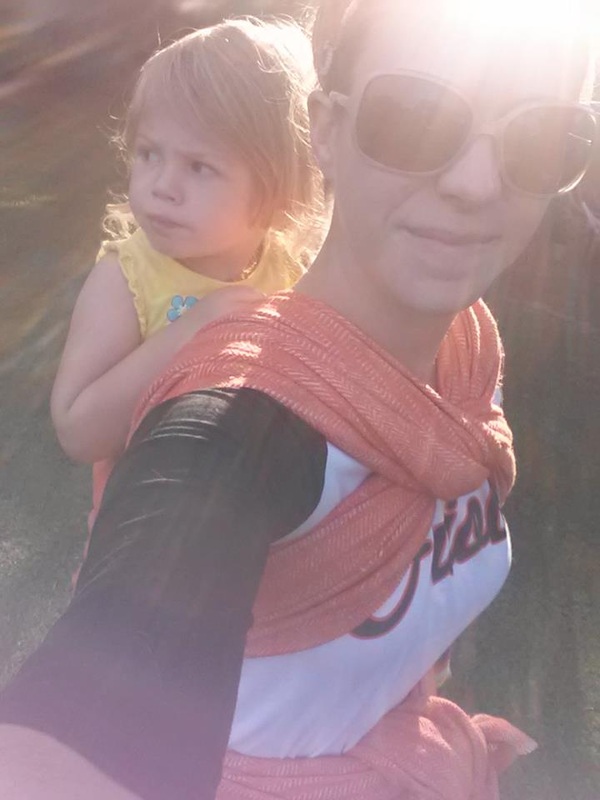
Inda Jani wraps, sold in the US primarily by 5 Minute Recess, are handwoven (yes, handwoven!) by artisans in Oxaca, Mexico. There are several different weaves and weights – the taffeta weave is a much thinner weave, while the tilli (herringbone) and fular (diamond weave) are both thicker. They are great budget wraps, especially considering that they are handwoven. All currently available Inda Jani wraps are 100% cotton.

Below comments refer to the herringbone weave wraps, but the diamond weave is very similar in wrapping qualities. These will wrap short as they have almost blunt ends (no taper to speak of). If you are planning on buying for wrapping, I would encourage you to buy one size up because of that. Be sure to wash the wrap when you first get it, as it arrives in “loom state” and will need to be washed and dried to minimize thread shifting. I would not consider them “crunchy” at all, but they do get even softer with use. These wraps are very cushy on the shoulders because they are thick – but the weave is also very open and airy, so they are not especially hot during the summer. Because they are thicker, they will make a larger knot when used as a wrap. Be aware that the weave can pull fairly easily because it is so open and airy, but it’s also pretty easy to work the pulls back in.

As wraps, these are fairly grippy (similar to a Girasol diamond weave). They are great if you think you have “picky shoulders” because they are very supportive and cushy cushy cushy, and will teach you to strand-by-strand tighten well. Because of the thickness, I would not consider them the best wrap to initially learn on – especially for back carries (I tend to like wraps that are a little thinner for that, just because they are easy to manage), but this is a wonderful baby to toddler wrap once you’ve got the hang of the basics of wrapping.

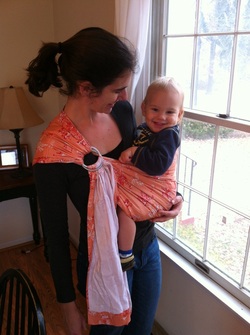
I own a pre-made (from 5 Minute Recess, with a gathered shoulder) herringbone ring sling, and it is by far my favorite ring sling to use with my toddler. It’s so supportive in a single layer ring sling carry, even with my 20 lb 2 year old! I highly recommend these as ring sling wrap conversions - they are even great for newborns as wrap conversions, as you don't have to worry about big knots and dealing with thick material in conversion pieces.

Cush: 4/5
Grip: 4/5
Newborn suitability: 2/5
Baby (6+ mos) to toddler suitability: 5/5
Suitable for wrap conversion (RS, MT, or Buckle): 4/5 (pulls may be a deterrent)
Measures: approximately 73 cm wide
Thickness: 270g/m2

Value: 5/5
Cost: $90 (3.2 meter/size 3) - $110 (5.2 meter/size 7)

Want to check one out in the lending library? We own a herringbone ring sling (orange tie dyed), a semi-wrap conversion mei tai (from Zanytoes – orange tie dyed), and a size 6 orange herringbone wrap (to-be converted into a RS soon!). We also own a size 7 orange wrap with fringe (this one is the thinner, taffeta weave and will be reviewed later).
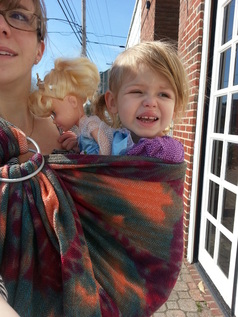
Picture
Inda Jani orange tilli/herringbone ring sling (tie dyed) from our Lending Library

1 Comment

Babywearing While Pregnant

4/8/2014

1 Comment

 
Picture
Babywearing while pregnant is a wonderful way to meet the needs of a soon-to-be big sibling.  Wearing a child while pregnant can be more comfortable carrying a child in arms.  

Before embarking on a babywearing journey while pregnant, be sure to consult with your midwife or obstetrician.  In most cases, if you are cleared to carry your child, you are also cleared to wear your child.  If you are on pelvic bed rest or asked not to lift your child, you should obstain from wearing them.  Instead, you can sit and have your child crawl into your lap for snuggles.   

Picture
While pregnant (and any other time too!) always listen to your body.  If a carry is uncomfortable, try something different.  There may be stages in pregnancy when one type of carrier or carry is comfortable and stages when the same carry is not comfortable.  It's also possible that babywearing won't be comfortable at all for you during pregnancy and that's fine too.  Just remember always to trust and listen to your body.  If it's not comfortable, don't do it.  


I've worn toddlers through two pregnancies now and this blog will share the tips and tricks that I've learned over the course of these two pregnancies.  I've created videos for each main carrier types with options that I have found comfortable at various stages of pregnancy.  What I've found comfortable has varied in each pregnancy and week by week during my pregnancies.  It takes a little trial and error to find a comfortable carry.  

Soft Structured Carriers

In my second pregnancy, I found using a soft structured carrier very uncomfortable and didn't use it at all.  With my third pregnancy, I loved using a soft structured carrier throughout the pregnancy.  I found it comfortable before 20 weeks with the waist belt clipped above my belly and after 20 weeks with the waist belt clipped below my belly.  This video shows both methods as well as a few tricks for getting a toddler safely on your back with a soft structured carrier.  

Mei Tais

Mei tais are one of my favorite carriers while pregnant.  Like with a SSC, before around 20 weeks, I find a mei tai really comfortable in a high back carry tied above the belly.  After about 20 weeks, I like to tie the waist belt below my belly and a little off to the side.  Tying a little off to the side allows me to spread out the width of the waistbelt strap to make a pregnancy support belt.  Another option with a mei tai is to tie tibetan with both the shoulder and waist straps, which creates a very comfortable carry with no weight on the belly at all.  

Ring Slings

The only way I can comfortably use a ring sling while pregnant is in a back carry.  This video shows how to do a safe back carry with a ring sling where the rings land at corsage level.  This is a great carry for a toddler (12 months or older) and for someone who is skilled with a ring sling.  In order to do this carry, a person should know how to neatly thread the sling, strand by strand tighten, approximate the size of the pouch, and make a nice deep seat for the toddler.  

Woven Wraps

Picture
Woven wraps are my favorite carrier while pregnant.  They are so versatile and there are a ton of different carry options.  My favorite carries with a woven wrap while pregnant are carries that tie at the chest or shoulder.  These are wonderful because there is no weight on my belly at all.  Below are a few videos of carries that are my favorites while pregnant.  

Ruck Tied Tibetan

Ruck tied Tibetan is a super quick carry that uses a longer wrap (sizes 5-7).  Tying Tibetan keeps the weight off of the belly.  When tying Tibetan, I like to spread the crosses of the Tibetan tie wide across my whole chest so that the weight loads evenly over my whole chest.  

Double Hammock Tied under the Bum

Double Hammock tied under the bum is a carry that uses a longer wrap (sizes 5-7).  The chest pass in this carry helps spread the baby's weight out and is very comfortable.  

Double Hammock Tied at the Shoulder

Double Hammock Tied at the Shoulder is a comfortable carry that uses a long wrap (sizes 5-7).  This carry has a chest pass that takes a lot of the weight load.  

Reinforced Rear Rebozo Ruck

Reinforced Rear Rebozo Ruck (also known as Pirate Carry because of it's abbreviation RRRR) is a carry that uses a shorter wrap (sizes 2-4).

Double Rebozo

Double Rebozo is a back carry that uses a shorter wrap (sizes 2-4).  

Ruck Tied Under the Bum

Ruck Tied Under the Bum is an advanced back carry, but very quick to do.  It uses a size 2-3 wrap and is excellent for quick ups and downs with a toddler.  Shorter wraps are small and easy to tuck in a purse or diaper bag and can even be worn as a scarf or pregnancy support belt while not in use.  

Other Comfortable Carries

There are a ton of carries with woven wraps that tie at the chest, shoulder, or under the bum.  These carries are all wonderful while pregnant because they don't put any weight on the belly.  Some of my other favorites are:
  • Back Wrap Cross Carry with Ruck Straps, Tied Tibetan
  • Jordan's Back Carry, Tied Tibetan
  • Giselle's Back Carry, Tied Tibetan
  • Reinforced Ruck, Tied Tibetan
  • Double Rebozo Shoulder to Shoulder, Tied under the Bum
  • Half Jordan's Back Carry

Remember always to listen to your body! 

Hopefully something here will be comfortable for you while pregnant, but remember always to listen to your body.  If you're not comfortable, try a different carrier or carry.  If that doesn't help make you comfortable, it's okay not to baby-wear during pregnancy.  Some people do not find it comfortable at all during pregnancy and that is fine.  Some people find it comfortable only during certain stages of pregnancy, and that's fine too.  Always listen to your body and only do what's comfortable for you. 
1 Comment

Ring Sling Tips and Tricks

3/23/2014

3 Comments

 
Picture
Having just gotten over a back wrap strike, I've been using my ring slings a lot more than usual with my toddler (who turned 2 in January). Ring slings have probably always been her favorite carrier, and we use them often for trips to the store and when we are out and about.

Advantages of ring slings:

  • Once you "get it", they are really quick and easy to put on
  • Compact and easy to stuff into a diaper bag
  • Not a ton of long fabric to worry about dragging on the ground while getting baby up
  • Super easy to nurse or bottle feed in
  • Sizing is incidental - meaning basically anyone can use a S/M/L, it's easy to pass off between caretakers, and will last you as long as you want to carry with still going from knee to knee on baby). Great for newborns all the way through toddlerhood!
  • Hip carries allow babies to see in front of you - this is a great alternative to "forward facing out" for people who are uncomfortable with or not ready for back carries and have babies who "want to see everything."

Disadvantages:
  • One-shouldered carries can get uncomfortable more quickly than 2-shouldered, especially with heavier babies/toddlers
  • Not great for leg straighteners
  • Not great for long-term back carries (pushing them to your back only for a couple minutes while you pay at the cashier or something is fine)
First off, a couple videos I made. Then the tips typed out below.
Basic Ring Sling Tips and Tricks
  1. Make sure the piece of fabric on your back is spread nice and wide. I usually reach around back with the arm on the ring side and spread it after everything else is done.
  2. Cap the shoulder. Pull the fabric over your shoulder a bit on the ring side. It helps distribute the weight. Note that if you are using a padded shoulder ring sling like a Maya Wrap, you may not be able to cap. I find those fairly comfy without capping, though, because the padding helps distribute weight and doesn't really dig into your neck.
  3. Try to aim to get the rings right under your collarbone - "corsage position" they call it (where a brooch or a corsage would go). There is a little wiggle room, and I find that too low is usually more comfy than too high (too high will dig into your collarbone). Though when rings are too low, it's harder to get the fabric high on baby's back. Because the rings do move as you tighten, see tips in the videos on how to get the rings in the right place, depending on how you are putting baby in (for babies who you are putting in from the bottom, start with rings just behind your shoulder. For smaller babies who you are putting in from above, pre-adjust and put them just a teensy bit higher than you want them to end).
  4. When making the seat, you want to get a nice deep seat (see relation of butt to knees in the bottom right pic). After she's mostly in, I reach between us and pull the fabric, thinking more "knee to knee" than up - the up high will happen naturally if you get a good bit of fabric from knee to knee. Knees should be higher than butt, and usually babies will sort of curve their back into you (rather than arching back, away - see examples in videos). Also note that the fabric is still high on my daughter's back (and she's a tall 2 year old!) even though I have that super deep seat. That's what you want. When you tighten stuff up, concentrate on tightening more or less only the piece of fabric that corresponds to the "top rail" of the wrap (also the middle a bit). The bottom is your nice, deep seat and should not need to be tightened.
  5. Though ring slings are for hip carries, they really aren't sitting actually on your hip. They are generally going to be higher than that if you've properly tightened, especially for smaller babies. Even my tall 2yo is still slightly above hip level, and smaller babies will be well above that.
  6. Again, when you pull to tighten, you should concentrate mostly on the pieces that adjust the top (mostly the top) and center of the wrap. You shouldn't need to tighten the seat at all, really, or you risk losing your seat. A lot of people try to over-tighten the bottom rail (probably one of the biggest mistakes), and end up losing their seat, or the fabric digs into the back of baby's knees, etc. Make sure that seat is tucked in nice and wide from knee to knee, and then just concentrate on tightening the top and middle.
  7. When you pull to tighten, pull (the top rail!) across baby's back/diagonal rather than straight down or out. That will help keep the rings in place better.
  8. As your baby gets bigger, you may want to upgrade to a thicker material. My Inda Jani RS is WAY more comfortable than my Girasol RS now, but I loved the Gira when she was smaller.
  9. This is a single layer carry, with nothing pinning the fabric in place. Expect that you will need to reach down and adjust/re-establish the seat every now and then - especially if you have a "seat popper". Also, because of the single layer nature of the carry, I try to avoid using one over slippery clothing on me or baby (I have a leather jacket that I wear a lot, and I always regret wearing it when I need to use the RS, as the seat tends to need readjusting more often because it has less grip).
  10. If you feel like baby is getting to heavy after having been worn for a while, try to shift things around. I often will shift my kid from more of a hip position to more in front of me and back just to get a little weight change for a bit. I also will readjust the shoulder if the weight is digging into one spot.
  11. If you are having trouble adjusting, make sure the fabric is not twisted in the rings. Refer to the longer video above for ring sling threading tips, or look for the great ring sling tips video by Jan at Sleeping Baby Productions. Also the "quick ring sling finger walk" video. Note that you also may need to lift up baby's weight with one hand while you tighten with the other (see videos again). Tension helps keep the fabric in place in the rings, so it *should* be difficult to tighten with baby's full weight on the rings - that means the sling is doing its job! :) If you have a new ring sling, tightening will also get easier as the sling gets broken in more.

How do I wash my ring sling?
  1. Unthread the fabric from the rings. To protect the rings, either put a sock over them or put the whole thing in a zippable pillowcase/washer bag.
  2.  Wash on cold with NO FABRIC SOFTENER, gentle cycle. Some people also recommend only liquid detergent, but I've used my DIY powder with no issues.
  3. If you are going to tumble dry, NO DRYER SHEETS (wool dryer balls are OK and encouraged, as they help break the wrap in and make it softer) and tumble dry as low as possible - expect some shrinkage, but usually you have enough length in a RS that it's nbd. I usually try to hang dry when possible. It will be a little "crunchy" afterward, but should break back in quickly after a couple uses.
  4. I generally wash my wraps alone, too, just in case there is some errant velcro hiding in the laundry or something that will bleed.
*Fabric softener and dryer sheets are not recommended because they are essentially a wax that coats the fabric and is tough to get off. Some say it can break down the fibers, and some say it can make the fabric less grippy (and you need some grip in all wraps). In my opinion, it's better to just avoid it, and soften using dryer balls or through use after a wash.


Picture
Ring Sling Shoulder Styles:
There are lots of different ring sling shoulder styles, and it is totally a matter of preference. Here is a breakdown of some of the most common. I encourage you to try out the shoulders on your own, though, because your opinions may be different than my own!
  • Gathered: This is my favorite shoulder style, because I think it gives a little "cush" and also allows me to move the fabric around so I can distribute the weight RIGHT where I want it. Some don't like that gathered shoulders tend to spread really wide, though.
  • Pleated (or SBP Pleated): These are gorgeous, but not my personal favorite (but it has plenty of devotees! And I have one and do use it (it's the one in most of these pics)). The pleats keep the fabric a little more organized and compact, but give you a little less control of where the weight goes.
  • Eesti: This has pleats on each outer edge, with gathers in the middle. A nice middle ground to give you more control on spreading, but keep the fabric from spreading TOO wide.
  • Some ring sling converters also have their own proprietary shoulder that is a combo of the above options: Comfy Joey, Oscha, etc.
Picture
Ring Sling vs Rebozo
A rebozo and a ring sling carry are essentially the same, except one uses a slip knot and one uses rings. I, personally, find ring slings much easier to adjust. Rebozos are great, though, because you are usually using a size 2 for them and can switch from rebozo to a size 2 back carry if you are out for the day and want more options. Some people prefer rebozo to ring sling, so it is again a matter of preference. Many of the above tips also stand for rebozo, but the adjusting process is a bit different. If you have a wrap and are unsure if you'd like a ring sling, try out a rebozo (you may need to tie extra fabric around your waist depending on wrap length) to see what you think!
Picture
You can also try a no sew ring sling if you have a pair of sling rings (you can borrow a pair from the lending library!). Note that no new ring slings are going to be harder to adjust than a real RS, because you have multiple layers of fabric you are pulling through the rings. But it can give you some idea of what a RS is like.
If you have any questions, ask here or on our Facebook page!
3 Comments

Tips and Tricks for Breastfeeding While Babywearing

8/5/2013

3 Comments

 
Happy World Breastfeeding Week!

In honor of world breastfeeding week, we have compiled some tips for nursing in a carrier.

Picture
First, it’s hard to learn to use a carrier and learn to nurse a baby for the first time all at once.  It’s easiest to master each individually before you put them together.  So get to know your baby and get the hang of nursing.  Next, get to know your carrier and get that down.  Then, you’re ready to put it all together!

Dressing for Nursing while Babywearing

When  you’re nursing in a carrier, it’s MUCH easier to have a shirt or dress that can be pulled down from the top than one that must be lifted from the bottom.  Scoop neck or V-neck tees are favorites of a lot of moms.  Nursing tanks are also easy to work with.  It’s difficult to pull up a shirt that is under layers of wrap (or straps/buckles) and baby.  

Picture

Nursing Upright

The simplest way is to keep baby upright and just lower baby to breast height.  This can be done in any carrier (mei tai, soft structured carrier, sling, or wrap).  Once you have baby at breast height, you can reach inside the carrier and aim your breast up toward baby to get baby latched on.  Aiming up is key to nursing in a carrier for many moms.  Typically, you’ll need a hand on baby’s head and a hand on your breast, at least at first.  
Picture

Nursing in a Cradle Carry

Picture
With a wrap or a ring sling, you can also nurse in a cradle carry.  In a ring sling, start with baby upright and tummy to tummy.  Loosen the sling slightly and take baby’s legs out of the sling on the ring side.  Guide baby’s head toward the opposite side from the rings.  You’ll need to keep a hand or elbow under baby’s head while nursing.   You can do the same in a wrap, but you’ll need to untie and adjust a little to get baby into a cradle position.  In a wrap, it might not be a full cradle carry, but more of a slightly tilted upright position. There are a few videos to show this below!

Supporting your Breast

Picture
Once you have baby latched on, there are a few tricks for supporting your breast.  What will work for you will depend on your breasts and baby, but here are some ideas:

  • Leave a hand inside the wrap/carrier to support your breast.  
  • Pull your breast on top of your shirt and allow the neckline of the shirt to support your breast.
  •  Leave your nursing bra latched (or even use a regular bra) and let your breast lie on top of the bra for support.
  • Tuck a small rolled up wash cloth under the breast to support it.
  • As your baby gets older, sometimes they will hold the breast at the right level themselves.  


Nursing Discretely

First, feel free to just nurse and not worry about nursing discretely.  Breasts are for feeding babies!  But if you’d prefer to be a bit more discrete here are a few tricks:

  •  Try it out in front of a mirror!  You’ll be surprised how much your baby’s head and the carrier naturally makes nursing a bit more discrete.  When you look down at yourself nursing, you can see your entire breast typically, but someone looking at you from across the room will probably just think your baby is sleeping.
  •  In a mei tai or soft structured carrier, you can shift the whole carrier a tad to the side you are nursing on.  Just take the waist and pull it gently toward the breast you are nursing.  This will give more coverage of the side of your breast while you are nursing. You can also use the hood of the carrier as an extra cover. 
Picture
  •   In a ring sling or wrap carry that ties at the shoulder, you can use the tails as cover.  You shouldn’t cover your baby’s entire head, but you can bring the tail up around baby to provide a bit more coverage of the top of your breast if you want.  
  • In a stretchy wrap or woven wrap front carry such as front wrap cross carry, the cross passes can provide great coverage.  You can also easily slide a hand under the cross pass to help baby latch or support your breast.  

Video Links

For those of you who are more visual, here’s a compilation of YouTube Videos which show how to nurse in a carrier:

Nursing in a Cradle Carry in a Woven Wrap or Stretchy Wrap

Nursing in a Ring Sling

Using a cradle carry:
Upright Nursing in a Ring Sling

Upright Nursing in a wrap with a Newborn

Nursing in a Mei Tai or Soft Structured Carrier

Babywearing can make nursing on demand super easy and convenient.  Even if it isn't always completely hands free, you are mobile and have at least one free hand for caring for other children, making sandwiches, pushing carts, or whatever you need to do.  Give it a little practice at home and before you know it you'll be nursing out and about anywhere with at least one hand free.  :) 
3 Comments

Wearing Two!

1/18/2013

1 Comment

 
Do you have two kids who look something like this?  
Picture
Babyearing can be a powerful tool for meeting the needs of two kids at once.  Strap them on and dance around the living room for a few minutes and you can turn that ^  (Yikes - someone call the exorcist!) into this:  
Picture
Ahh.  Much better.  So let me start by saying there are about a zillion different possibilities for wearing two kids.  I'm going to link a few ideas and videos here organized by type of carrier(s) and hopefully it will be something to get you started.  

Got Two Ring Slings?

You can put two babies into hip carries using two ring slings.  

Got a Mid-length Woven Wrap and a Pair of Sling Rings?

Try Jasmin's Tandem Hip Carry.  This carry puts two babies into hip carries that can be separately adjusted without the bulk of two ring slings.  

Got a Long Woven Wrap?

There are tons of ways to wear two kids in one woven wrap.  With this first method, you put one baby on your back in a ruck and the second baby in the front in the crosses of a tibetan tie.  This works with twins or with siblings of different ages.  

Got Twins and a Stretchy or Long Woven Wrap?

With a long woven or stretchy wrap, you can do Pocket Wrap Cross Carry with twins in each cross or Front wrap cross carry with twins on each side of the pouch.  This is a great method with smaller babies (under about 12 lbs) and allows for both babies to be on the front.  

This video shows how to tie PWCC and demonstrates the carry with dolls:
http://s391.beta.photobucket.com/user/morse_family/media/Babywearing%20more%20than%20one%20or%20twins%20videos/M4H09772.mp4.html

This next video shows the carry pretied, but demonstrates putting in twins with real babies rather than dolls.
 
This video shows a variation on Front Wrap Cross Carry that can be done with twins to get both babies on front in a nice snug carry.  This can be done with a stretchy wrap or a long (size 7) woven wrap.  

Got Two Woven Wraps?

With two wraps, the possibilities are endless.  It's easiest to pretie or semi-pretie a front carry.  Front wrap cross carry or Front cross carry are great carries to pretie or partially pretie on front.  After pretying the first wrap, you can do a back carry of your choice with the child in back.  Then, add the front child to your pretied carry on the front.  This video shows a pretied pocket wrap cross carry with a stretchy wrap and a ruck back carry.  
You can also put one baby on the back and then hook the second wrap onto the first one. Note:  This method should only be done with a wrap back carry.  It is not recommended to thread a short wrap through the straps of a soft structured carrier or mei tai because these carriers are not designed to withstand the weight of a second child at the shoulder straps.   

Got Two Mei Tais or Two SSCs?

It's also possible to use two mei tais or two SSCs or a combination of the two.  Here's a video that shows a twin tandem carry with two SSC's.  
The possibilities are endless.  There are also great forums and groups for tandem wearing support.  One is the tandem babywearing facebook group and another is thebabywearer's wearing more than one forum.  


Happy Tandem Wearing!  :-)
1 Comment

Carrier Pros and Cons

12/13/2012

1 Comment

 
Shopping for a new carrier can be really daunting!  There are so many types and acronyms!  How do you know what will work for you?  We've compiled a list of pros and cons of each type of carrier which can help you decide what you think will work for you and your baby.  And course, you can try all of these at any meeting and even borrow one for a month to figure out if it's really right for you and your baby.  

SSC's (aka - Soft Structured Carriers)

Picture
Soft Structured Carriers (SSCs) are basically buckle carriers. They have a waist buckle, square of fabric, shoulder straps and often a chest clip.

Pros: 

  • Quick to use
  • Easy to learn to use
  • Once you figure out your perfect settings there’s little to no adjusting for future uses
  • The more structured waist provides lots of back support for toddlers/preschoolers
Cons: 
  • It can be tricky to find your perfect setting
  • It can be tricky to get a good fit for two very different sized parents
  • They are the least adjustable to fit the child. You may have to buy different sizes as your child grows from infancy to toddlerhood
  • Often not comfy to sit when front carrying
  • Not particularly comfy in a hip carry

Mei Tais

Picture
Mei Tais (pronounced “may tie”) are a square of fabric with straps for the waist and longer straps for the shoulders. They are just like SSC’s but instead of buckles, you tie a knot with the straps.

Pros:

  • They can fit multiple wearers
  • They are very adjustable
  • There are adjustments that can make mei tais comfy while pregnant
  • A mei tai allows for a high back carry, which many babies who like to see out really love

Cons:

  • There is a small learning curve
  • The straps are long and can drag on the ground
  • Not particularly comfortable in a hip carry

Ring Slings

Picture
Ring slings are basically a long fabric with two rings at one end.

Pros:

  • Quick, especially for a baby/toddler that wants up and down frequently or while running quick errands
  • Allow for a comfortable hip carry, which babies who want to see out usually love
  • Provide excellent support for a newborn
  • Can be inexpensive
  • Easily adjustable for switching between adults.
  • Easy to nurse in discretely

Cons:

  • Can become uncomfortable with bigger babies (25lbs or heavier) for longer periods of times
  • One shouldered carries are not typically comfortable for extended periods of time
  • There’s a little learning curve

Stretchy Wraps

Picture
Stretchy wraps are a long (typically 5 meters or longer) slightly stretchy fabric. 


Pros:
  • Inexpensive
  • You can pre-tie and pop baby in and out
  • Provide great positioning and support for newborns
  • Very soft and moldable for newborns
  • Can easily fit multiple adults
  • Warm and snuggly in winter
  • Wonderful for skin to skin time

Cons:

  • Many people find them saggy or less supportive after the baby reaches 20lbs
  • Cannot be used for back carries
  • There’s a slight learning curve
  • Depending on the brand, they can be too warm for summer time

Woven Wraps

Picture
Woven wraps are long non-stretchy fabric.  They come in varying sizes (basically lengths from about two through six meters) and different carries can be done with different sizes.  


Pros:
  • Infinitely adjustable
  • Can be used for front, back, and hip carries
  • You can pre-tie and pop baby in and out of hip or front carries
  • Allow for high back carries
  • Can be used from birth-preschool
  • Can easily fit multiple adults

Cons: 

  • There’s a steeper learning curve
  • Depending on the carry, wrapping can take a few minutes
  • Cumbersome for wearing older kids who want up and down frequently unless you use a pretied carry
  • The long length of fabric tends to drag on the ground while wrapping

1 Comment

    Archives

    September 2015
    August 2015
    July 2015
    June 2015
    May 2015
    April 2015
    March 2015
    February 2015
    January 2015
    December 2014
    November 2014
    October 2014
    August 2014
    July 2014
    June 2014
    May 2014
    April 2014
    March 2014
    February 2014
    January 2014
    December 2013
    November 2013
    October 2013
    September 2013
    August 2013
    June 2013
    May 2013
    April 2013
    March 2013
    February 2013
    January 2013
    December 2012
    November 2012

    BWI of SO MD

    Babywearing International of Southern Maryland's mission is to promote safe and comfortable babywearing and to build a community of families in Southern Maryland.

    Categories

    All
    Breastfeeding
    Carrier Reviews
    Cold Weather
    Mei Tai
    Newborn
    Photo Tutorials
    Pregnancy
    Ring Sling
    Sponsors
    Ssc
    Stretchy Wrap
    Tandem
    Twins
    Woven Wrap
    Wrap Carries By Size

    RSS Feed

Powered by Create your own unique website with customizable templates.